










PERFECTION


*Departments and titles are as of the time of interview.

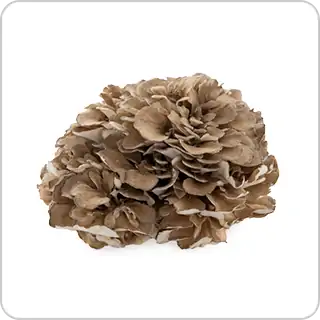
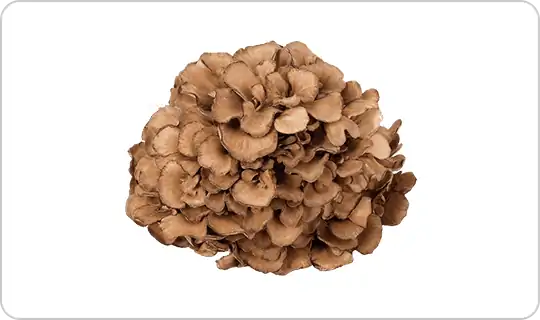
Yukiguni Factory has long been committed to mass-producing maitake—valued for its rarity and high nutritional content. In 1995, the company began developing a strain that would surpass its existing varieties. Over the next 20 years,the team continued to experiment through trial and error.
In 2015, they finally succeeded in creating the long-awaited “Kiwami” strain, overcoming numerous challenges along the way. What setbacks, frustrations, and moments of joy did the developers experience as they took on the challenge of creating an entirely new in-house strain?

In the 1980s, Japan was swept up in a gourmet boom. French and ethnic cuisines grew in popularity, and around the early 1990s—the bubble-economy era—there was an explosive craze for Italian cuisine. Through these diverse food trends, Japanese eating habits became richer and more varied. Maitake too evolved beyond its traditional role in hot-pot dishes, finding its way into menus that transcended national and culinary boundaries.
Its potential as an ingredient expanded dramatically.
In 1991, amid these shifts, the company established a new Research & Development Laboratory to solidify its position as a pioneer in mushroom-production technology. At the time, maitake cultivation relied on an external strain purchased from a spawn maker—“Strain A,” widely regarded as the starting point of the maitake industry for its excellent flavor. However, when cooked it produced a dark broth that diminished a dish’s appearance, and depending on the recipe the texture could be lacking. Although the R&D team worked to improve quality, those weaknesses proved difficult to overcome.
In 1995, senior management made a bold shift.
“We will develop our own maitake strain”—to strengthen our business foundation without relying on external suppliers,
and to offer products with a unique appeal.—
The determination was strong, yet developing a strain entirely in-house was a first for the company—the beginning of a tentative journey into uncharted territory.
Within the R&D Department, development of the in-house strain was led by Harumitsu Kojima.
“It wasn’t particularly difficult to lighten the color of the caps,”
he recalled. Having spent three years in Production, Kojima had firsthand experience of how difficult Strain A was to handle. For example, even under identical temperature settings, growth differed between the hot summer and the sub-freezing winter. From spring to autumn the clusters formed beautifully, but in winter it was often hard to achieve the ideal shape, and high-quality yields declined. There were even days when supply visibly dropped.


“A strain must be well-balanced overall. Even if the broth is lighter and the flavor is good, if shelf life is short or if stable quality cannot be maintained year-round, it is out of the question.”
General Manager, R&D DepartmentHarumitsu Kojima
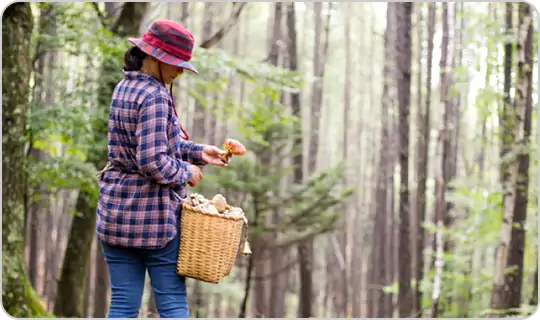
To begin developing an in-house strain, Kojima first gathered raw materials for breeding—wild maitake. He headed into the mountains around Muikamachi and Tokamachi, and to the Iide mountain range straddling the Yamagata–Fukushima border. He relied on local foragers to enter the mountains and search on foot, and he visited remote areas with roadside stands to purchase maitake. When none were for sale, he handed out his business card and said, “If you find any, please let me know.” Using his days off, he traveled from place to place—often sleeping in his car—relentlessly pursuing wild maitake. In autumn, whenever he heard that natural maitake were being sold at stands, he rushed over; more than once, he returned home late on Sunday night with mushrooms in hand.
The search continued for years. Kojima initially worked alone, but later junior colleagues joined and the group of three or four explored on weekends. Even seasoned foragers would literally dance with joy when they found wild maitake — the name maitake, “dancing mushroom,” refers to exactly this joy of discovery. Although maitake is said to grow at the base of large mizunara oaks, it is not easily found. In fact, Kojima harvested wild maitake in the mountains only three times over several years.
“Surprisingly, one was right next to a private home,”
he exclaimed—his excitement still vivid.


The painstakingly collected maitake was crossbred to begin selective breeding. To choose strains that met the objectives, it was vital to assemble materials with the widest possible genetic diversity. The team gathered as many wild strains as possible, photographed each specimen, assigned numbers, performed tissue isolation, and transplanted them onto cultivation beds. The R&D Department accumulated data on shape, flavor, color, shelf life, and more of the cultivated maitake.
"Breeding maitake strains felt like searching for hidden treasure; I enjoyed that kind of work. But we were dealing with living organisms—they don’t stop growing on weekends. Every day we entered the incubation rooms; we were “soaked in mushrooms.” Once after work, a stranger asked me, “Aren’t you from Yukiguni Maitake?” Even my clothes had absorbed the scent of maitake."


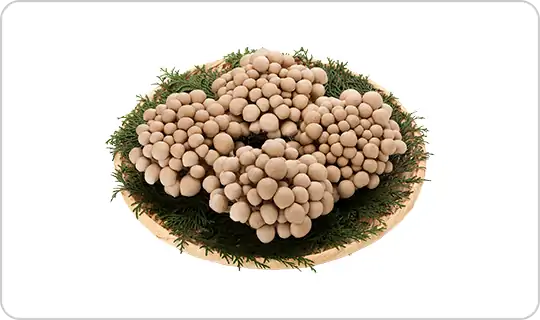
The in-house strain was completed in 2000 and named “Y10M” (short for Yukiguni Maitake No.10). Five full years had passed since the start in 1995; during that time, R&D conducted more than 1,000 large-scale crossbreedings. From this vast pool, they narrowed down and selected Y10M as the closest to the ideal. A year of factory trials confirmed stable production. For an internal presentation to management, Kojima prepared dishes such as maitake steamed rice and maitake fried rice. With lighter colored caps, the broth was clearer and the texture delightfully crisp. With confident, he awaited good news—yet the reply was not so positive. Management said, “It cannot become our main variety,” not because of taste but due to low productivity. While Strain A yielded over 800 grams per block, Y10M produced around 700 grams. Despite its appearance and texture, it could not replace Strain A because of cost. Kojima was disappointed but his work was not over. He reset his mind: “On to the next strain.”
After that, Y10M’s excellent flavor was approved internally, and in 2004 it debuted as a premium product, “Shaki-Shaki Maitake” – “Crisp Maitake”. However, as a high-price item, demand remained limited and production did not increase. Sales continued mainly to urban soba restaurants seeking high-quality ingredients. Akihisa Namekata, who managed Y10M cultivation in the Production Division at the time, recalls:


“At the lowest point, we harvested only about 200 roots once a week. It was truly modest. Even so, Y10M had resilient caps with a good bite and maintained a beautifully rounded shape year-round. Although slightly smaller, its firmness meant less collapse and less waste—ultimately improving productivity.”
Senior Exective Officer, Division Director of Production Division
Akihisa Namekata
At one point, the Sales Division raised the concern that “there is no customer to sell to,” and the discontinuation of Y10M production was even considered. However, the Division Director of Production Division, who was Namekata’s supervisor at the time, strongly valued the quality of Y10M, saying, “It would be a shame to stop”. Although it became a decision made at the discretion of the production site, we chose to continue the mass-production trials of Y10M without scaling them down.

“Producing maitake only once a week required more work than expected,”
says Katsunori Mukaikawato, who was involved in the trial cultivation.


“When Y10M was cultivated under the same conditions as Strain A, undesirable characteristics appeared. We therefore used Y10M-specific cultivation conditions and management techniques. Precisely because the volume was small, all the factors that made cultivation difficult came together.”
Section Chief, Bio Center No.1Katsunori Mukaikawato
Y10M placed burdens on the production site, but everyone acknowledged its high quality.
When we expanded the space for mass-production trials, changes emerged. Mukaikawato continues:


“As we increased cultivation volume, quality improved. The winter quality—an issue with Strain A—rose to a 95% good-product rate with Y10M. It was an eye-opening figure.”
While in-house strain development faltered, another effort was underway: revising the substrate to increase Strain A’s productivity. In 2012, a new substrate tailored to Strain A’s characteristics was completed. In maitake cultivation, growth changes with the combination of substrate ingredients and techniques; consequently, Strain A and Y10M had different substrate compositions. Toru Kawase, who knows the production site well, recalls the struggles of adjusting the ingredient mix at the time.


Director, Bio Center No.1
Toru Kawase
At the production site, we then took a bold step and
applied the new Strain-A substrate to Y10M as well.
“Substrate formulations are adjusted to each strain’s nutritional needs, but we had to reconfigure the production line for small-volume Y10M. When you are dealing with 20,000 units per day, that is quite a burden.”

Director, Bio Center No.1
Toru Kawase
At the production site, we then took a bold step and
applied the new Strain-A substrate to Y10M as well.

“The Factory Manager later said, ‘We did it without permission and got a serious scolding from my boss.’ It was an experimental attempt, driven by the desire to ease the strain at the site.”
Kawase had been considerate of his boss—but then something unexpected happened. The new substrate performed beyond expectations, proving more compatible with Y10M than with Strain A and boosting Y10M’s yield significantly. Riding this momentum, the production team implemented further improvements to cultivation techniques. By 2014, Y10M exceeded 800 grams per root, standing shoulder to shoulder with Strain A. Around the same time, a new management team came in, which also worked in Y10M’s favor. “Why leave such a good strain underused?” Backed strongly by new management, all Strain-A production was switched to Y10M. In August 2015, the new brand “Yukiguni Maitake Kiwami” debuted—twenty years after the start of R&D.

Having witnessed this entire sequence, Namekata offered this assessment of Kiwami’s long journey to its launch:
"The new management team came from outside the mushroom industry and chose the Kiwami (Y10M) strain with clear, unbiased eyes. They valued texture and flavor over productivity, which was truly encouraging for those of us who had kept producing it, however modestly. The motivation for moving Kiwami to the new substrate was likely, “If the substrate is unified, it’s easier—and what happens if we grow them the same way?” Likewise, gradually expanding the space for mass-production trials reduced hassles at the factory site, ultimately enhancing the value of the Kiwami strain."

“Yukiguni Maitake Kiwami” has since continued to improve quality and productivity through refinements to substrate and cultivation environment. Today, its yield exceeds 900 grams per root and it has a dignified presence. Their supple, beautiful caps are neatly packed and lined up in stores—sights that still bring a smile to Kojima.
*Departments and titles are as of the time of interview.